Five lines pressed into clay.
The Vari table carries five parallel lines and ten depressions. A decorated die from the same disturbed assemblage was judged probably associated—not certainly so.
C-011–C-019A game known by a modern name
Five Lines
Plato could turn a move from the sacred position into a metaphor. Theocritus could move a counter from a line without stopping to explain the game. We no longer know the procedure behind the image.
Follow the evidencecenturies of clues
Ways to play
The evidence trail
The trail begins with clay, moves into heroic imagery, and then slips into philosophy and poetry. It looks cumulative. That is the trap: every object and phrase preserves something different, and none is a rulebook.
The Vari table carries five parallel lines and ten depressions. A decorated die from the same disturbed assemblage was judged probably associated—not certainly so.
C-011–C-019Exekias names Achilles and Ajax and records announced throws of four and three. The board cannot be read, so the game cannot be named.
C-025–C-027An unusual legislative move is compared with counters moving from the sacred position. The metaphor survives. Its mechanics do not.
C-004Theocritus slips the move into a scene of erotic reversal. He writes “line,” not “sacred line,” and gives his readers no rules lesson.
C-005 · C-034A Praenestine mirror is identified by the British Museum as a five-lines scene. Another surviving plate shows seven lines. Both are clues; neither is a manual.
C-020 · C-028Two players. Five counters each. Five lines. A middle line called sacred. A quoted fragment associates the counters with dice throws. Then the entry stops.
C-001–C-003 · C-035–C-037Eustathius preserves difficult, late testimony about the sacred line and carries an expression attributed to Alcaeus. “Towards” is not “reaches”—and not “wins.”
C-006 · C-007 · C-039The fragments can constrain a modern game, but they cannot complete one. Every playable version must disclose where evidence ends and design begins.
C-043–C-046 · C-053–C-065Cleared documentary images
These are real ancient objects, not reconstructions. They can show the recurring heroic gaming image and variation in line counts. They cannot supply movement or victory.
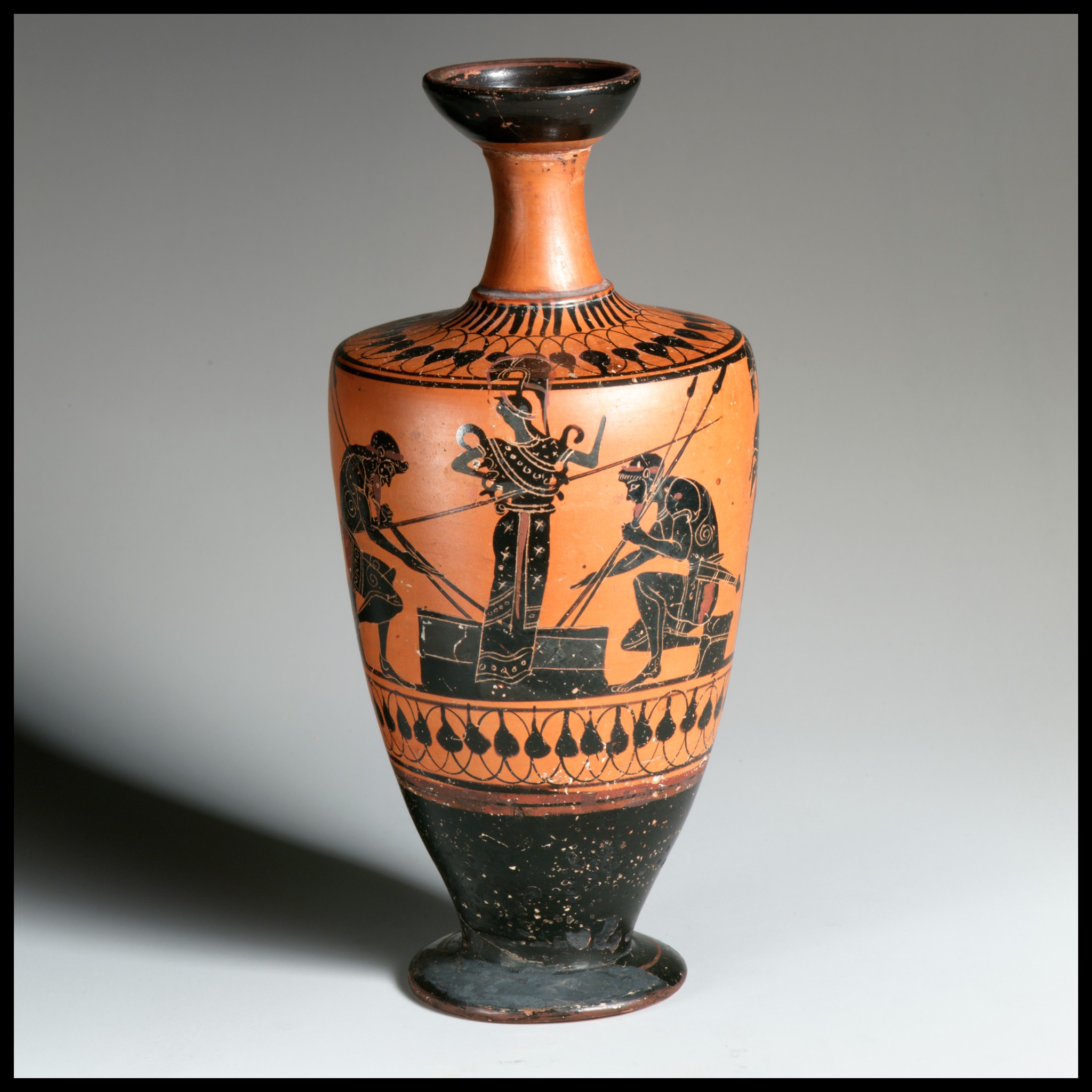
Achilles and Ajax at a board game, with Athena between them. The game is not identified and the scene preserves no readable rules.
Terracotta lekythos, related to the Painter of Vatican G.31, late sixth century BCE. The Metropolitan Museum of Art, 62.11.2. Public domain (CC0). Object record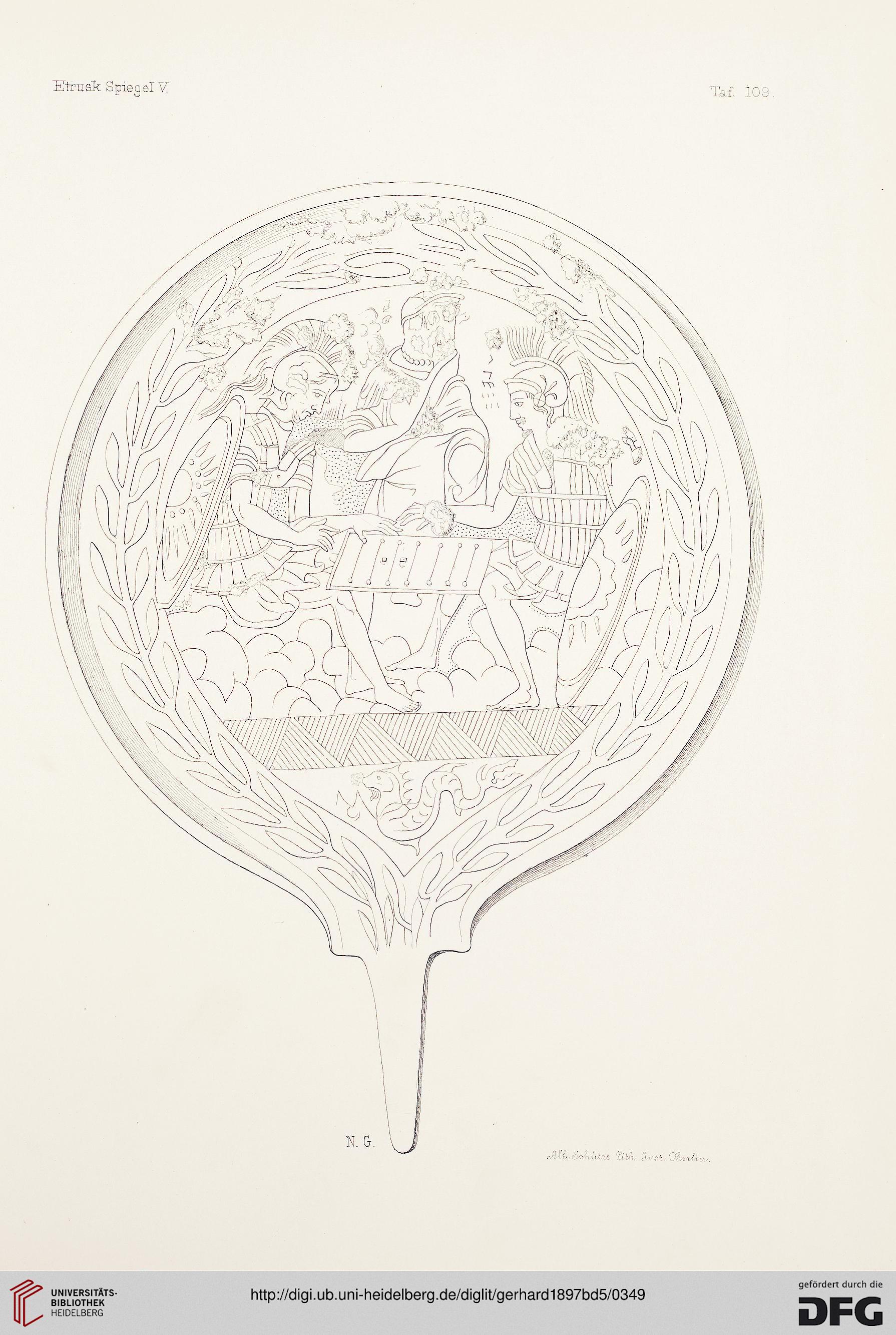
A seven-line heroic gaming scene. Its value is difference: surviving line-game images do not reduce to one five-line form.
Etruskische Spiegel, vol. 5, plate 109 (G. Reimer, 1897). Heidelberg University Library. Public Domain Mark 1.0. Digitised plateThe second disappearance
Ancient moments and modern survival are two different clocks. A phrase can be early while the witness carrying it is late. These paths meet on this page, but they are not one continuous chain.
Late second century CE
By the ninth century
What survives is epitomised: abridged and interpolated, still recognisably Pollux, but not guaranteed word-for-word in every cluster.
C-037 · C-038An early expression
Twelfth century
It reaches us through commentary, not a reviewed Alcaeus papyrus. The crucial word is damaged and reconstructed; another remains uncertain.
C-006 · C-039Early third century BCE
c. 1180–1186
Idyll 6 survives by its own reviewed route in a Constantinopolitan manuscript—not as the next link after Eustathius.
C-040 · C-041The texts remember moves without boards.
The boards preserve shapes without moves.
The evidence matrix
Enough to constrain a reconstruction. Not enough to complete one. Each row keeps the surviving fact beside the choice it cannot make for us. Some related marked surfaces could instead be abaci. Calling the middle line sacred preserves a name, not a religious meaning.
Pollux describes each of two players.
Turn order and starting player
Pollux gives five counters to each player.
Entry, stacking, capture and return
Pollux says five; the Vari table has five. Other tables vary.
The route through or around them
Pollux preserves the name hiera grammē.
Why it mattered or what it did
A quoted fragment mentions throws; a Vari die was probably associated.
Die count and movement procedure
Circles, cavities or modelled counters appear at opposite ends.
Occupancy and the lines’ mechanical job
Still missing
The reconstruction problem
Each answer tries to explain a surviving clue. Each also has to invent the procedure that the evidence no longer supplies.
The blockade race
The capture-and-yoke race
Perimeter Line Battle
Our answer
Perimeter Line Battle separates movement from conflict. Counters travel around the outside; opposite endpoints belong to one contested line. A larger force threatens a smaller one. The defender gets one move to reinforce—or lose the formation.
These rules are ours. The ancient ones are gone. Here is what the evidence allowed, and where we had to choose.
1 v 1 Neither side has superiority.
2 v 1 The smaller formation is pinned.
2 v 2 One reinforcement restores parity.
3 v 2 The response window opens again.
Play the question
We cannot hand you the game Plato’s readers knew. We can hand you the evidence, show every choice we made, and let you test what those choices become in play. We do not claim to have recovered the ancient rules.